Source: http://www.optimization-services.com/meta.asp?ID=4
seo leaders online traffic mystic good backlink see book link building
Source: http://www.optimization-services.com/meta.asp?ID=4
seo leaders online traffic mystic good backlink see book link building
seo tools seo tool land seo leaders online traffic mystic good backlink
Source: http://www.trafficmystic.com/232/make-a-podcast-the-entices-listeners/
Google collects a lot of information on individuals & can have some level of confidence if the person is a real person or not based on things like their history of email usage, if they have a credit card on file, how they interact with other high confidence real accounts, how many people are friends with them on Google+, usage of an Android cell phone, their search history, etc.
Google doesn't need all those signals on any individual, just some blend of them.
From there they can create a lot of usage-based brand signals.
For any keyword Google can see the search volume & the click distribution on the search results.
If a lot of people click on the top result & very few people click on the second or third result there is a strong chance the keyword is a brand. If the click distribution is spread more evenly across the search results then it is less likely to be a brand keyword.
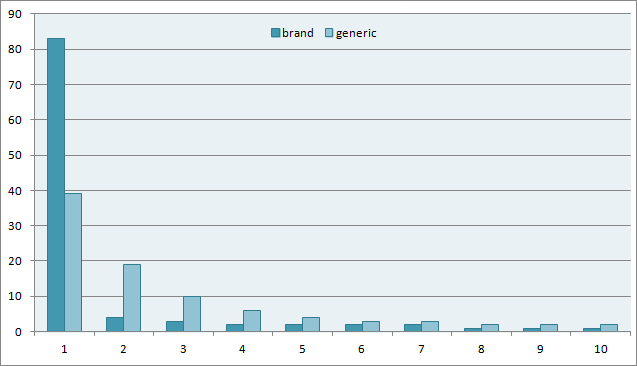
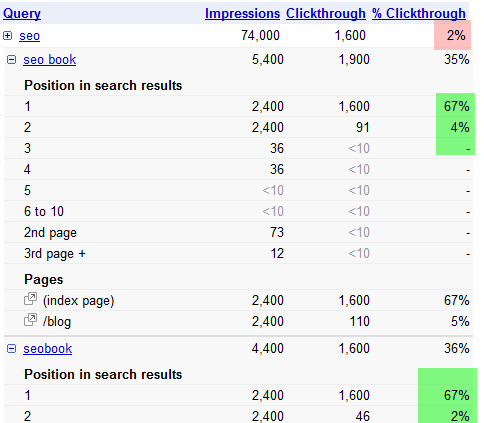
The above was a hypothetical example, but the following image shows how lower volume branded navigational keywords can drive far more traffic than broader industry keywords. We get twice as much traffic for seobook & seo book as we do for seo.
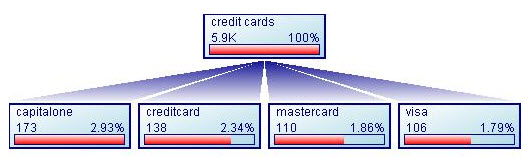
When people search for a generic keyword they may (immediately or later) modify their search query to search for related keywords. In the past Microsoft offered a search funnels tool that would show common searches before & after a keyword. If someone searched for credit cards they might soon search for visa or mastercard.
Shortly after Google's Vince update, a Googler described the algorithmic change as being attributed to query chains.
Of course getting the user to click is just the first step. From there you must satisfy them. ;)
If you visit a page quickly & then jump right back to the search results Google asks users for an explicit vote against that site.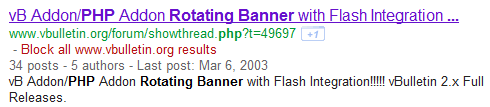
And if you visit a page for a significant period of time Google asks users for an explicit vote for that site.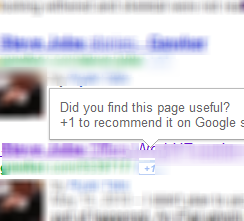
That Google is measuring the time until return the search results to determine which explicit vote to request also implies that they can use the same aggregate data to create an implicit signal.
Where this measurement can get a bit fuzzy is that Panda can create a self-reinforcing impact (good or bad).
Some examples...
Let's say your site got a ranking boost by Panda. It will rank higher across broader industry keywords, to where people may enter your site at the category level (say shoes or Nike shoes) and then surf around your site quite a bit. This equates to a longer time on site & a better user experience.
2 more factors on this front are branded navigation & familiarity.
On some search results Google shows branded search options.
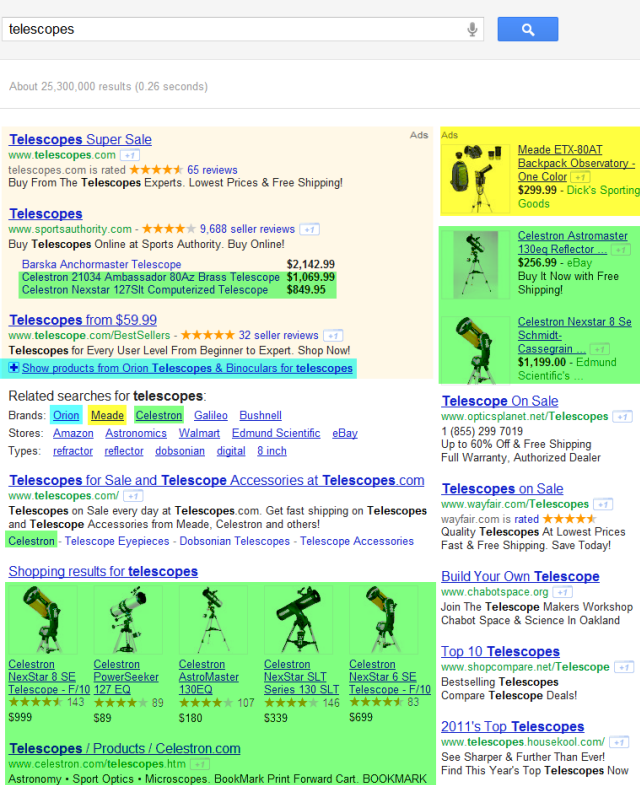
If clicking those brand & store links feeds into the Vince relevancy signal, then any brand featured there has a huge wind at their back, building further brand signals. Eventually such suggestions can work their way into Google Instant keyword suggestions as well. Even if people do not click on those particular options, the various highlights in the search results act as advertisements for the brands, which drive incremental demand and search volume for those brands.
Amazon.com is responsible for roughly 1/3 of ecommerce spend in the United States (outside of travel), so many people might go and research product options generally & then conclude those search sessions by seeing if they can buy it off Amazon.com (due to getting free shipping & the high level of user trust Amazon has). As this becomes part of search relevancy algorithms this is the online equivalent of going to your local Borders store to find something to buy & then buying it on Amazon. In the short run you save a few Dollars, but in the long run stores like Borders go out of business.
There are 2 bad ways a business can be impacted by Panda. One is missing out on the above promotional options that a large competitor may enjoy, which over time build more brand signals for them & leave your site stranded in no man's land until it is finally clipped by Panda for lacking "quality."
A second issue is a self-reinforcing issue with Panda. On WMW a user nicknamed Walkman described it as the "size 13 shoe problem." After you have been hit by Panda you are not likely to rank for broader category level searches. However you might still rank for some really obscure longtail keyword that is uneconomic to address directly (and thus only have a glancing mention of the user's intent). Your page might say we do not carry size 13 or size 13 out of stock and your Panda-hit site ranks for "Nike Carmelo Anthony size 13." Thus the user bounces, creating a self-reinforcing negative user experience signal.
A third (non-Panda) issue that can cause poor user experience metrics is when Google mutates the search query in a way that makes the organic results irrelevant.
Google has long used reviews in their ranking algorithms & even made a tweak to demote businesses with negative reviews.
The above examples of +1 votes and blocks can be used (along with the time on site & repeat visits) to gauge user satisfaction, however if they can't get enough engagement then it will be very easy for big brands to buy that signal for pennies on the Dollar, as some social signals are easily bought by brands.
Not only does Amazon directly integrate promoting your wishlist on social media ...
... but they also have done interesting promotions like a "Tweet & get" ...
Imagine if/when a new local Wal-Mart store launches offering a free $10 coupon to everyone who Tweets their savings at the checkout counter!
One big issue I have with the +1 votes & blocks is that they apply across the board. I may dislike some craptastic videos hosted on YouTube, but there is also a lot of great content there. I love eBay for vintage video games, but it does not mean I love them for books.
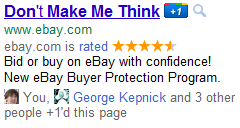
Likewise some of the friend of friend stuff can be a bit off.
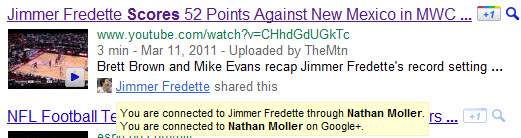
At some point Google should make +1 votes & blocks more granular.
Near the end of this article I will also further discuss some issues with ad votes.
Does Google measure repeat visitors? Yes.
They use that user interaction to ask for an explicit vote...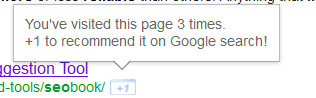
...and they can use it as an implicit vote as well.
They not only track how many times you visit a page or site, but also when you last visited it.
Once it is obvious Google is counting certain types of user metrics (just like they count links) there will be a race to the bottom to provide those said signals. That race to the bottom will lead to such signals being sold by accounts that either have sketchy trust metrics associated with them (if done through automation) and/or in markets with lower living costs.
In addition to AdSense & Google Analytics, Google has huge search market share, a widely distributed toolbar and their Chrome web browser. They can track where language is used in certain ways and where a site is popular
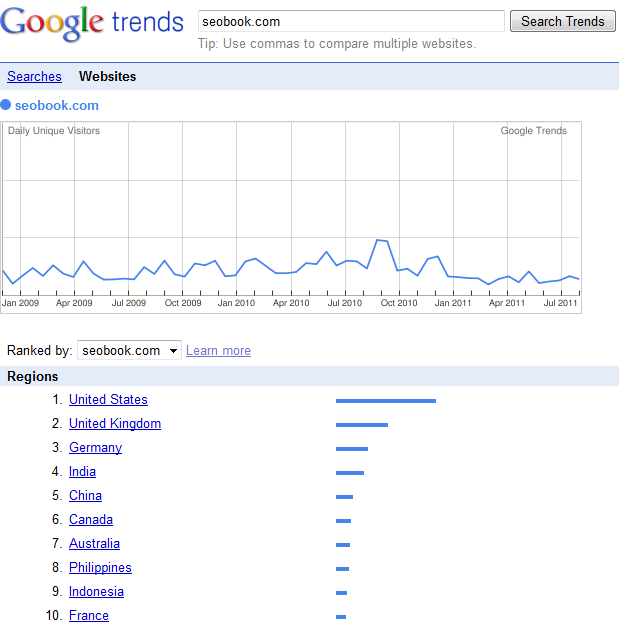
And they can also track where the votes come from.
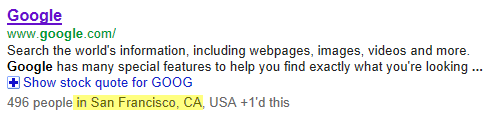
If your domain name matches your keyword that may be a brand signal. However, Google may also look at some other signals (like user engagement, repeat visits, relative CTR, etc.) as confirmation signals on this front.
Sometimes when a spammer builds links they trap themselves by using the same anchor text too much. Whereas when a branded website pulls in organic citations the anchor text tends to be mixed up, like...
http://www.paypal.com
www.paypal.com
Pay pal.com
paypal.com
pay pal
Paypal
paypal payments
etc.
Diversity in any sense (anchor text, linking sources, pages being linked to, links built across time, etc.) is generally considered a good thing.
Other types of links might also be seen as potential brand signals. For instance, frequent exposure in trusted news sites, other trusted seed sites, or other known brand sites could pass additional karma. Some link spikes that are also associated with strong direct traffic spikes, strong referral traffic from the links, and strong brand searches might also boost the weight given to links.
Any type of non-search distribution you have (RSS subscribers, email newsletters, mobile applications, physical stores, membership loyalty programs, etc.) makes it easier to influence search engines.
If advertising with Google had a negative impact on search relevancy you can be sure that the relevancy algorithms would change. Whereas if there is a convenient positive spill over then Google won't complain. In fact, they will even go out of their way to advertise that spill over. Any sort of advertising you do increases brand awareness. And that leads to additional incremental brand searches (and thus brand signal)
More exposure also leads to more user experiences, which in turn leads to more opportunities for people to leave signals behind (be it links, social mentions, additional brand searches, and/or repeat visits). Here is State Farm buying *irrelevant* brand signal for pennies on the Dollar.

And of course there are all sorts of corporate advocacy ads as well.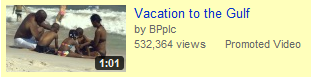
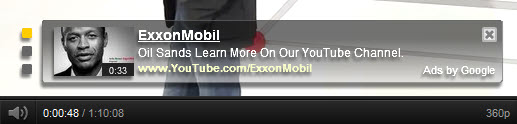
On YouTube Google counts some ad views as organic views (thus undermining relevancy) and more recently Google has implemented the controversial policy of putting +1 buttons in display ads.


Even if those votes don't influence rank directly, they still influence user perception. And what is so bad about that is that users are only voting of the content of the ad. This basically is the equivalent of cloaking.
If the landing page doesn't match the ad (free iPad anyone???) then people are going to see their friends vouching for scams & get duped by Google.
That is worse that a press release being advertised as though it was news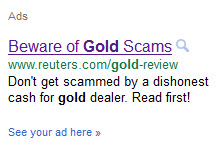
You can also be certain that some clever spammers are integrating +1 buttons in display ads on other ad networks in ways that may automatically collect user clicks & so on, or have users pay for viewing their next porn video by clicking a +1 button (much like some old school email spammers used porn viewers as manual captcha breakers).
Google does offer the ability to vote against an ad as well, but if an ad looks great upfront & its the landing page that scams you then how exactly do you vote against it if you don't see the site until after you click the ad?


Source: http://www.seobook.com/potential-brand-signals
seo leaders online traffic mystic good backlink see book link building
Source: http://www.google.com/tools/firefox/toolbar/FT3/intl/en/
use seo seo tools seo tool land seo leaders online traffic mystic
"All things are subject to interpretation. Whichever interpretation prevails at a given time is a function of power and not truth." - Friedrich Nietzsche
Being labeled as open or transparent is a great public relations strategy. Executed effectively it gets ditto heads to feel like they are part of a movement and spread your propaganda.
However actually being transparent is often a poor business strategy.
When WordAds opened up someone in the comments suggested that they should win by being open like Google. I read that and laughed. Where Google is losing you can count on them pushing the open label in order to build momentum & destroy the asymmetrical information advantages of existing market leaders. But where Google leads non-transparency is the norm.
A few examples & comparisons:
Calls for "transparency" in SEO may sound great on their face, but once you peal back the covers the absurdity is laughable. If Google didn't discriminate against certain types of players & if Google didn't compete in the very markets that it judges then perhaps transparency would be a good idea.
However Google is perhaps the single biggest direct competitor in many markets, so to be fully transparent with them when they are the opposite with you is a naive business strategy:
I also disagree that outing each other would make the industry less like a mafia, because SEOs aren't the mafia. SEO is a symbiotic marketing channel reliant on Google, until the next big search engine/method comes along. In a mafioso analogy, Google would be the mafia - as they control the market. Removing all webspam wouldn't necessarily create better search results or a fairer market, as Google still decides who wins and who loses. The biggest winner being Google itself, the next level being their friends.
Secrecy is also the cornerstone of all marketing channels. Social Media for instance works in a similar way to SEO, except they have secret voting methods rather than secret linking methods. You don't see major social media companies outing a rival's voting methods, as it would shine a torch on their own methods. Even outside of marketing, McDonalds probably worked out KFC's magic blend of herbs and spices decades ago, but it's not in their best interest to tell everybody.
Outing webspam helps an SEO blog to keep their UVs up and their VCs happy. It helps a failing newspaper to appear modern and edgy, whilst allowing the contributor to launch a protection racket off the back of another company's misery.
How often do you see tier-1 public relations firms marketing themselves by smearing other PR firms?
You don't.
You might see a company like Google hire a PR firm to push a bogus study to smear the security of a competitor, but you rarely (if ever) will see one PR firm smear another in the media.
While some of the more intellectually challenged members of the SEO industry associate search spam with molesting children (talk to Google about that after their recent Chrome fiasco), those with a bit of intelligence and/or experience realize that many of the issues are gray and murky. What one person considers as spam one day they later sell as "advanced" months or years down the road. The ecosystem isn't some static black & white code:
The question is less whether black hat and webspam are a good thing or not, but if Google is the unbiased and benevolent instance who shall make the rules. Google is a business and persuits its very own interestes, since it is aware of its market power with a lot of arrogance, aggresivity and obviously double standards. That was also Aaron's point, but seomoz has been missing the point completly in the last time.
I expect an SEO portal/community to focus on how stuff actually works/can work, not to propagate how the monopolist does it want to work. It is their risk of doing business if they decide for an algorithm, not ours. It is our risk however, to decide whether to stick to the rules or not. And it's not only about ethics but has several practical implications...
On paid links Google claims to require machine AND human readable disclosure. Then on their own site they use an ad color background that literally fades to white on many monitors. Maybe it is legitimate that they are only able to fool some of the users some of the time. But some of their ad initiatives have 0 disclosure at all. None.
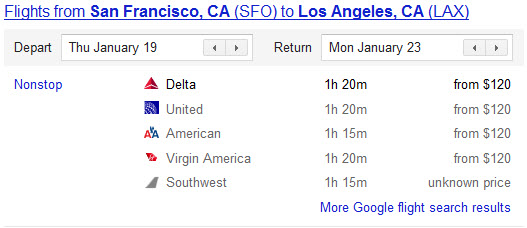
That is now part of the "organic" search results, but is that a paid ad?
You wouldn't know by looking at it, but according to the WSJ it is: "Google lists booking links to the airlines as advertisements, but the company declined to comment on how much money it makes from the arrangement."
There is no disclosure that you are in a paid ad funnel until the very last click. And those who fail to pay are either unlisted, listed last, or have a broken booking process where their brand is arbitraged in an attempt to flip the click to somewhere else. According to Leocha, ?Google and the airlines have a sweetheart deal with each other, and the consumers are getting screwed.?
In the hotel market Google is also testing comparison ads & price ads.
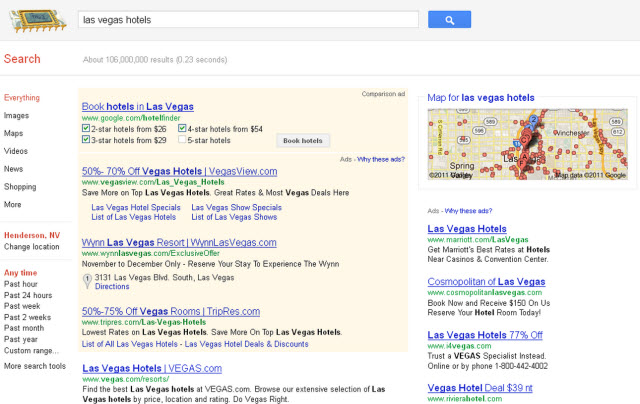
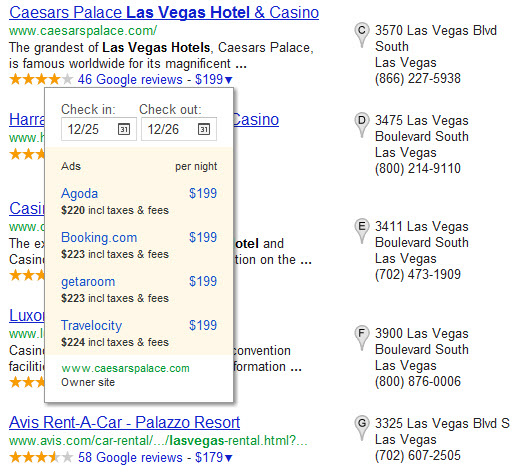
Notice how little they care about relevancy so long as they keep the click on Google or are paid for the referral. They rank the car rental company Avis as a top Las Vegas hotel! And even the ad links that are sold off of that do not line up. Priceline pushes the Plazzo Luxury Suites & Booking.com pushes the Venitian.
What do you suppose the above behavior does to cash flow & multiples of websites in that vertical? Of course it contracts them & retards investment. Who wants to start a new hotel website at this point? What other verticals have investment held back by the fear of Google's eventual entry?
If you only had to manage competing against other market competitors & staying inside Google's editorial guidelines then investment isn't that difficult, but if you have to stay within Google's guidelines in the short term yet try to build a business that is sustainable even after Google enters & destroys the market it is far more difficult.
At any time Google can enter any market and skim off the cream: "An independent study from Leads360 showed consumers using Google?s comparison ads converted better than any other lead provider."
Other affiliate networks which do not own the search channel have to fight through quality issues if they try to build similar scale.
When Google enters a market it might buy out a competitor, buy out a supplier, bundle, use predatory pricing, grant themselves superior search placement, adjust the relevancy algorithms and/or editorial guidelines, violate IP, scrape 3rd party content, work with sketchy advertisers & publishers to undermine competing business models, or any combination of the above.
They are rarely transparent with their interests when they enter a market. Almost everything is labeled as "a beta" and "just a test." They promise to "act appropriately" & you may not be aware of the steamroller until you are under it.
When the +1 button & Google+ launched, Google highlighted how they would use the + button usage as a "relevancy" signal. Google recently started inserting + pages directly into the search results for brands & right from the very start they were using it as a scraper website that would outrank the original content source.
Google used the buy in from their promised relevancy signal to create a badge-based incentivized system which acts as a glorified PageRank funnel to further juice the rankings of these new pages on a domain name that already had a PageRank 10.
I recently read a blog post about how anyone could do the above & the opportunity is open to everyone. But the truth is, I can't state that something will become a relevancy signal that manipulates the search results in order to get buy in. Or, if I did something which actually had the same net effect, Google would likely chop my legs off for promoting a link scheme.
Recently the topic of Google+ as a scraper site came up yet again via Read Write Web & on Hacker News a Googler stated that it was "childish" to place any of the blame on Google!!!!!!
Google determines how much information is shown near each listing & can create "relevancy" signals in ways that things tied to Google get over-represented (look at the +1 count here). When they do that & it destroys other business models *of course* Google deserves 100% of the blame.
It may be more profitable for Google to squeeze out some of the players, but if Google's quest for free content manages to destroy business models & the ecosystem as a whole, then they are not "doing what is best for the user."
Google can bundle themselves into markets, but when others do the same it is a big no no:
A Google spokesman said "applications that are installed without clear disclosure, that are hard to remove and that modify users' experiences in unexpected ways are bad for users and the Web as a whole."
Google's founding research highlighted how bad ad-driven search engines were & then Google's core revenue engine of paid search was built on their violation of Overture's patent. They keep buying swaths of patents to protect against their other violations.
The business model of "violate & then buy protection" has helped lead to a protection-racket styled marketplace in patents that makes the risk of innovation for smaller players so expensive that it drives them under.
Where Google has gained a dominant position in a marketplace they can begin misdirecting for profit. Let's say you link to your own location on Google Maps to drive traffic to Google & help your users locate your office. Well in some cases they then reciprocate by confusing users by putting an ad in your location bubble.
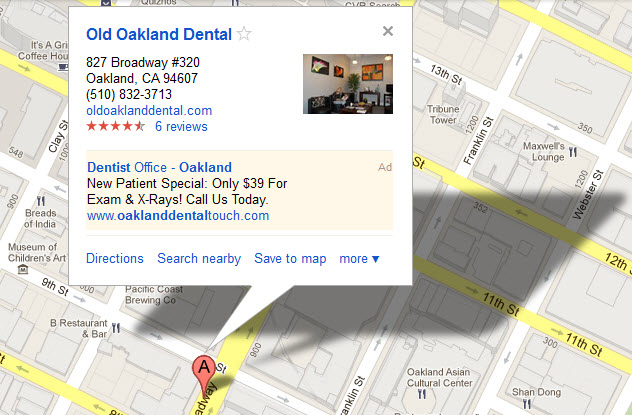
Once again, you are forced to buy your own brand unless you teach your customers (and prospective customers) to avoid Google products.
If you are fully transparent against an arbitrary set of guidelines when the company that judges you also competes against you & brushes up against the limits of the DOJ & FTC then you might lose for no reason other than being transparent. And not only are you competing directly against Google, but the algorithms are biased toward certain players.
In 2006 Google's Eric Schmidt admonished others for attempting to create a 2-tier web:
Today the Internet is an information highway where anybody ? no matter how large or small, how traditional or unconventional ? has equal access. But the phone and cable monopolies, who control almost all Internet access, want the power to choose who gets access to high-speed lanes and whose content gets seen first and fastest. They want to build a two-tiered system and block the on-ramps for those who can?t pay.
But when Google launched their Panda algorithm they did the same thing.
Their "quality content" thesis could have come across as being honest if they weren't still pre-paying Demand Media to upload "content" to YouTube.

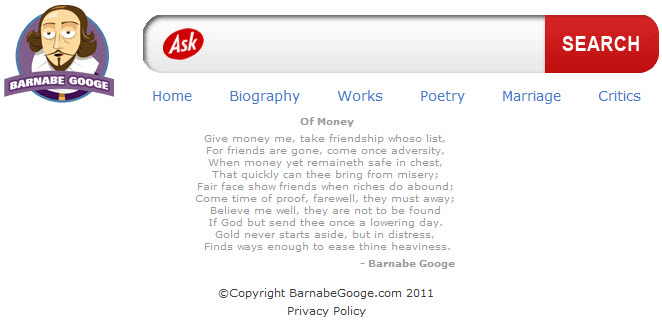
You might get smoked by a Panda update or have your accounts arbitrarily frozen while operating at a 7 out of 10 level, and then you see Ask is Google's biggest advertiser, their arbitrage gets a pass, & that feed even monetizes misspelled searches for Google's brand. ;)
Risk is needed for adaptation, so some amount of risk is good, but...
If the old established corporate competition needs to be as good as you to compete then there is little risk to being transparent if the competition is doing nothing beyond following you around. But if the playing field is tilted and the competition only needs to be 5% as good as you are to beat you (and can easily come from behind to copy any success you have) then full on transparency brings much more risk than potential profits.
We are moving into a media world where the content becomes ads & even how people interact with the ads and content becomes a part of the ad.

Further Google uses their data advantage to create other asymmetrical advantages. While credit card companies sell personalized ads in network, Google is creating a marketplace to buy and sell user data.
Every time you view a page and click an ad (or even don't click an ad) you are feeding highly personal data back to Google. And they will use it as they wish. Here they are saying thousands of people like eBay, which is of course plenty reasonable, except for the fact they claim the people voted for that specific page rather than the site as a whole.
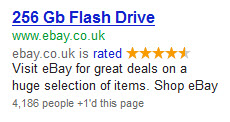

What's worse is that sometimes they will put your picture next to a listing and claim that YOU PERSONALLY voted for a specific page & use that to market that item to your friends and contacts. The problem with this is that:
Once again, I will highlight that they use the votes against the wrong sites & pages and that they keep showing the votes even weeks after you remove them.
Where is the transparency in that deceptive crap?
But Aaron, you are just being hard on Google, why don't you ever mention Ask or Yahoo! or Bing?
I did mention Ask above. ;)
Bing has done numerous self-serving things, including some that are flat out sketchy.
Yahoo! offers a useless "buying guide" for fish tanks that is nothing more than a paid pointer to Overstock.com.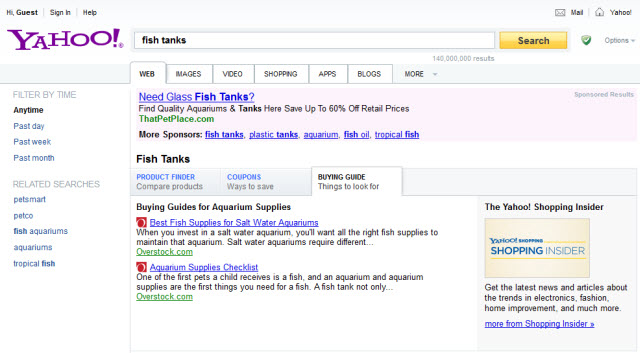
If you click on their coupons tab on that fish tanks search Yahoo! shows you coupons for tank tops, which is pretty idiotic.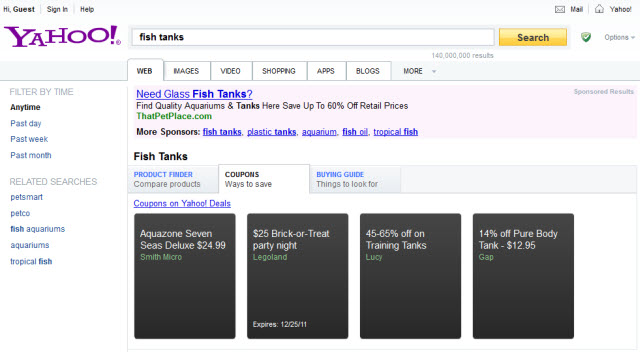
Why is this Yahoo! Shopping & Yahoo! Deals product so ugly? They outsourced it years ago. So it is a non-product & thus the integration can't be anything but crappy.
Why do Yahoo! & Bing typically get a pass? They own a fairly low search marketshare. Missing traffic from either or both of those is certainly significant enough to be felt, however even when they are combined it is still less than half of what Google controls in most markets. Market leaders are expected to operate in less conflicted & less self-serving ways than also ran players in their market do. If Microsoft would have had 10% or 15% marketshare for their operating system then it is unlikely their browser bundling would have come under such scrutiny.
In the past I highlighted how every form of media is manipulated in Why Outing is Bad, but I thought it would be fun to run through some other markets and highlight how transparency often exists only as an illusion (to lure in punters so they can be rooked).
TrueCar aimed to make that market more transparent by giving consumers pricing data online to remove some of the asymmetrical advantage dealers have & makes the sales process smoother for consumers. How does the automotive market respond? Honda issued threats to their dealers & now TrueCar has a hate video ranking for their brand.
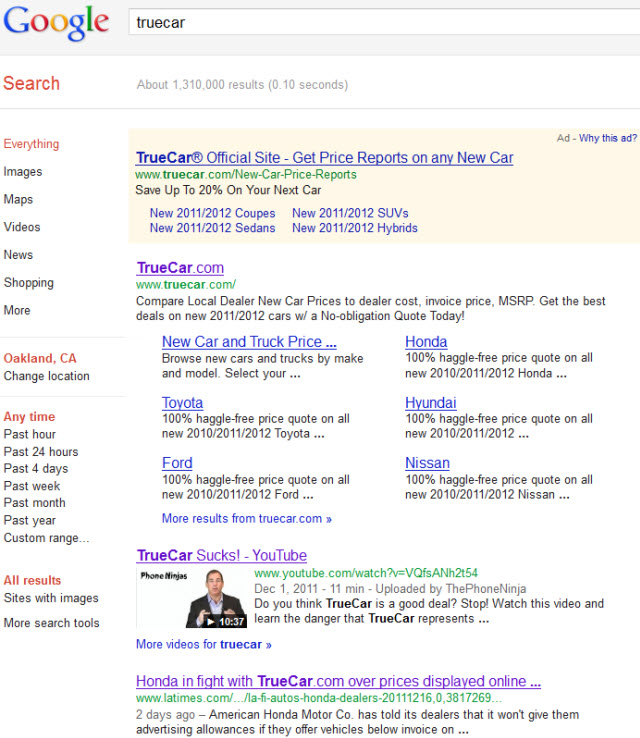
This nontransparency is not something new, but rather the way it has always been.
It exists at every level of society. Countries spy on one another & companies may chose to show different views of the world to different markets.
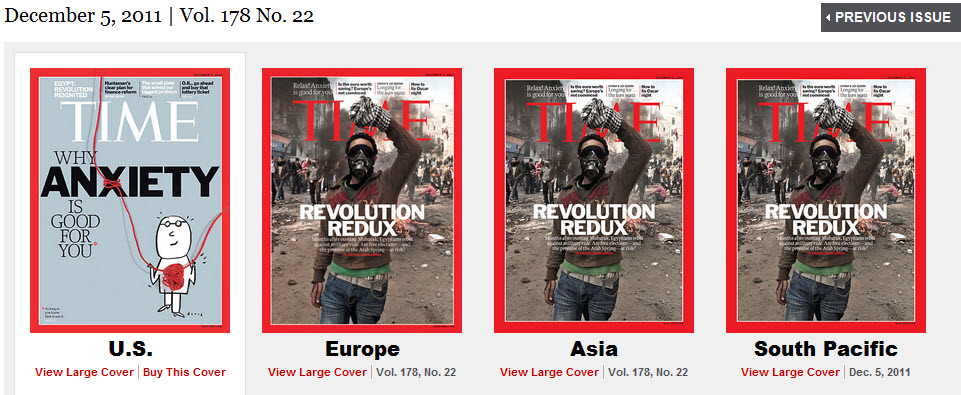
And what they do internally doesn't match the story they share publicly. Look no further than the News of the World's hacking scandal:
News International?s leading profit centre, the News of the World, was dependent on a very ugly culture of lawbreaking, hacking and impunity. This freewheeling, ask-no-questions attitude spread to other parts of the organisation, such as the Times and the Sunday Times, both of which used have used illegal or unethical techniques. Even more troubling, when senior News International management were confronted with evidence of wrongdoing, the company made false statements and took actions which prevented key evidence from reaching the public domain.
The same company has not only been accused of hacking at some of its other news outlets (by its own employees no less) but was also accused of similar in other lines of business:
Both cases involve News America Marketing, an obscure but lucrative division of the News Corporation that is a big player in the business of retail marketing, including newspaper coupon inserts and in-store promotions. The company has come under scrutiny for a pattern of conduct that includes below-cost pricing, paying customers not to do business with competitors and accusations of computer hacking.
Going back into history it is sort of hard to pick a starting point (one can go to the spice trade & orders that are unsealed at sea, or likely earlier than that) but to pick a somewhat recent starting point, we could look at the railroads:
So how did unnecessary, inefficient railroads get built? Because of government subsidies. In short, the federal government paid to build the railroads through massive financing subsidies and also gave them ample land grants. The trick to building a railroad was not knowing anything about railroads or even about business; it was having friends in Washington who could give you the right financing and land subsidies.
Even then, the railroads lost money. Not only was there insufficient demand for their services, but they were run by people who were generally incompetent. (For one thing, they didn?t even know their own costs of doing business.) Yet the people who owned the railroads made fabulous amounts of money (of which Stanford University is one symbol). The main way to do this was simple. The people who controlled a railroad (generally by putting up very little of their own money, thanks to the government subsidies) would also wholly own a construction company. They would cause the railroad to overpay the construction company to build the railroad?in effect transferring wealth from railroad stockholders and creditors into their own pockets
What did the Robber Barons invest in? In large part government, media & educational institutions so that they could help "educate" society on how to behave much more civilly than they have.
There are tons of marketing campaigns designed to "educate" society about the impacts of various companies. BP now markets the gulf coast economy they plundered.
AT&T's astroturfing campaign to acquire T-Mobile was so over the top that it actually backfired.
"Get the facts" styled campaigns are rarely about promoting a complete worldview.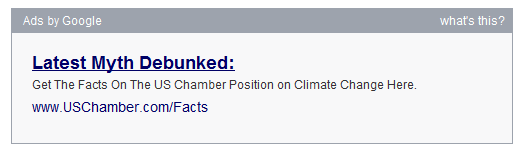
Remember the $500 million fine for Google from them pushing ads selling overseas Viagra in the US? Now they promote scaremongering ads against fakes from filthy labs.
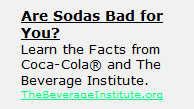
Coca-cola runs The Beverage Institute & has "doctors" highlight how healthy soda is.
At the same time, when Pepsi was sued over an alleged rat being in a can of Mountain Dew. Pepsi's defense claimed: "the mouse would have dissolved in the soda had it been in the can from the time of its bottling until the day the plaintiff drank it" turning the mouse into a 'jelly-like' substance. But don't worry folks, it's healthy. :D
At least we still have water.
When they are not busy making it illegal to collect rainwater, Bechtel wants you to follow them on Twitter.

It is hard to know what is in our food & those who label things as organic have to fill out more paperwork than those who manufacture frankenfood. Then there are the baseline chemicals sold as biodegradable which are not. ;)
Oh well, at least we have insurance.
State Farm is the #1 ranked bad faith insurance company, but at least they upload & advertise irrelevant funny videos to YouTube to create brand signal for Google.
Of course some of the worst affiliate offers, the most aggressive sales calls & other scams are designed to prey on ignorance of small print & rebilling, but even generally good businesses practice in asymmetrical skimming.
A few recent examples:
When one looks at the field of finance it is story after story of deception, nontransparency & lawlessness. It is a constant reminder that there is no such thing as business ethics.
The above makes no mention of helping Greece hide governmental debt, bid-rigging bribes in Jefferson County, robosigning bogus foreclosure documents, and a host of other crimes. But one thing in common with all the above crimes is this: no jailtime for the banksters.
Since there is nothing stopping those criminals they keep up their crimes:
Big banks represent the ultimate in concentrated economic power in today?s economies. They are able to resist all meaningful reform that could really change their compensation schemes. Their executives want to get all the upside while facing none of the true downside.
But capitalism without the prospect of failure is not any kind of market economy. We are running a large-scale, nontransparent, and dangerous government subsidy scheme for the benefit primarily of a very few, extremely wealthy people.

The actions of the financial cartel are both obvious & predictable. And the damage they do is felt worldwide:
Credit-financed economic booms, by turns in private then public credit as one ratchets up the other over a series of booms and busts, are as irresistible to politicians as hookers and maids.
...
The failures of American FIRE Economy policies are behind the movements in Libya, Yemen, and Syria, as reflation measures, from quantitative easing to currency depreciation, steal purchasing power from low income families world wide, acting as the most regressive tax imaginable. Simmering hatreds are exacerbated by the developing global crisis over oil supplies and costs.
...
The so-called debate about debt ceilings, spending cuts, and entitlements reductions is a red herring. The public debt crisis arose from the 2007 - 2008 private credit market crisis, not the government liabilities that have been building for decades. The mistake of both the left and the right is thinking that we can escape an output gap without facing up to the politically unpopular task of demanding that creditors take a loss on loans taken out during the credit bubble era.
A creditor that makes bad loans deserves to go out of business. Their outsized compensation can't be justified unless they are also made to eat their losses. But rather than holding them accountable for their own actions, societies the world over absorb that pain.
"Fascism should more appropriately be called Corporatism because it is a merger of state and corporate power"- Benito Mussolini
There are currently more slaves alive than at any point in history. And many people who are not slaves are still being enslaved by crushing debt:
Money is a human construct. The fact that our money is now backed by nothing more than our collective future ability to "produce" relegates us to that of slaves.
Money=paper=blood hours.
Blood hours are a finite measure. Heartbeats.
What's in your wallet? Is it the new debt slavery card: "A personal bankruptcy is supposed to cut borrowers loose from lenders and debt collectors, but Capital One Financial Corp.?one of the nation's largest credit-card issuers?sometimes doesn't want to let go."
Citigroup has an "effective" strategy they employ in some 3rd world countries to deal with those who can't pay:
After dropping his younger daughter at school, Octa walked into Citibank?s credit card collection department on the fifth floor of the Jamsostek tower just after 10 a.m. Four hours later, he left the 25-story building slumped motionless in a wheelchair -- a victim of what police allege was a violent assault by debt collectors. Driven to a nearby hospital in a Citibank car, Octa was pronounced dead on arrival.
Unfortunately, even if you stay out of debt, you are forced to support banking scams:
before being bailed out by governments, banks had never made any return in their history, assuming that their assets are properly marked to market. Nor should they produce any return in the long run, as their business model remains identical to what it was before, with only cosmetic modifications concerning trading risks.
So the facts are clear. But, as individual taxpayers, we are helpless, because we do not control outcomes, owing to the concerted efforts of lobbyists, or, worse, economic policymakers. Our subsidizing of bank managers and executives is completely involuntary.
In the US the reason the government debt outlook is so bad is in part due to overpaying for "assets" owned by the likes of Citibank:
The way the banks make money now is by hiding their losers off balance-sheet, or by forcing them on the taxpayers, and after having themselves declared "systemically important," adjusting their on balance-sheet exposures accordingly, crashing the system and cashing out on their leveraged derivative bets, also at the taxpayers' expense.
In real life, if there is such a thing anymore, all of the major banks are arguably insolvent. So, in reality, they're not making any money at all, they are merely having it transferred to them by their political operatives in Congress and the Federal Reserve Bank. This, after all, is the modern purpose of the Congress, and has always been the purpose of the Federal Reserve System.
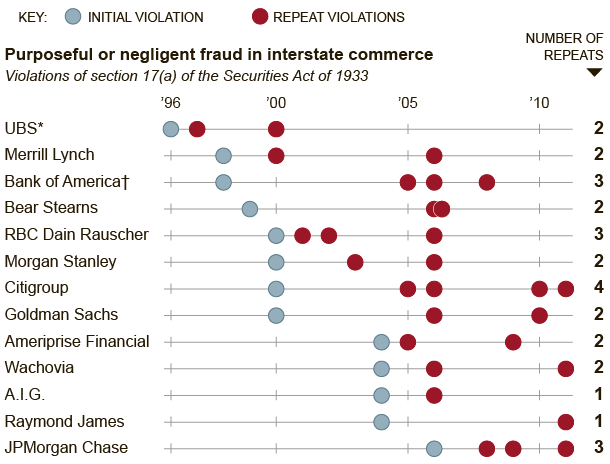
Even as they destroy savings, kill jobs & undermine the competitiveness of the economy, why does the government continue to support such scams? Without the scams & cost-shifting those in government wouldn't have as much wealth, power & influence. It is debt & cost-shifting that fuels them:
government and banks are stuck together like a couple of dogs screwing and we don't know which is on top. Here, Republicans need government to finance war and Democrats need it to finance social programs. Both need it to finance both, as that is how government attempts to maintain power and influence over the people this day and time.
The congress literally sells insider tips to hedge funds:
When Senate Democrats finally brokered a compromise over the proposed health-care law, a group of hedge funds were let in on the deal, learning details hours before a public announcement on Dec. 8, 2009.
The news was potentially worth millions of dollars to the investors, though none would publicly divulge how they used the information. They belong to a select group who pay for early, firsthand reports on Capitol Hill.
Since most money comes into circulation as debt (and due to the compounding nature of debt interest), if those at the top are not allowed to fail then those at the bottom will fall hard:
In the past, periods dominated by virtual credit money have also been periods where there have been social protections for debtors. Once you recognize that money is just a social construct, a credit, an IOU, then first of all what is to stop people from generating it endlessly? And how do you prevent the poor from falling into debt traps and becoming effectively enslaved to the rich? That?s why you had Mesopotamian clean slates, Biblical Jubilees, Medieval laws against usury in both Christianity and Islam and so on and so forth.
Since antiquity the worst-case scenario that everyone felt would lead to total social breakdown was a major debt crisis; ordinary people would become so indebted to the top one or two percent of the population that they would start selling family members into slavery, or eventually, even themselves.
Well, what happened this time around? Instead of creating some sort of overarching institution to protect debtors, they create these grandiose, world-scale institutions like the IMF or S&P to protect creditors. They essentially declare (in defiance of all traditional economic logic) that no debtor should ever be allowed to default. Needless to say the result is catastrophic. We are experiencing something that to me, at least, looks exactly like what the ancients were most afraid of: a population of debtors skating at the edge of disaster.
And, I might add, if Aristotle were around today, I very much doubt he would think that the distinction between renting yourself or members of your family out to work and selling yourself or members of your family to work was more than a legal nicety. He?d probably conclude that most Americans were, for all intents and purposes, slaves.
...
Clearly any pretence that markets maintain themselves, that debts always have to be honored, went by the boards in 2008. That?s one of the reasons I think you see the beginnings of a reaction in a remarkably similar form to what we saw during the heyday of the ?Third World debt crisis? ? what got called, rather weirdly, the ?anti-globalization movement?. This movement called for genuine democracy and actually tried to practice forms of direct, horizontal democracy. In the face of this there was the insidious alliance between financial elites and global bureaucrats (whether the IMF, World Bank, WTO, now EU, or what-have-you).
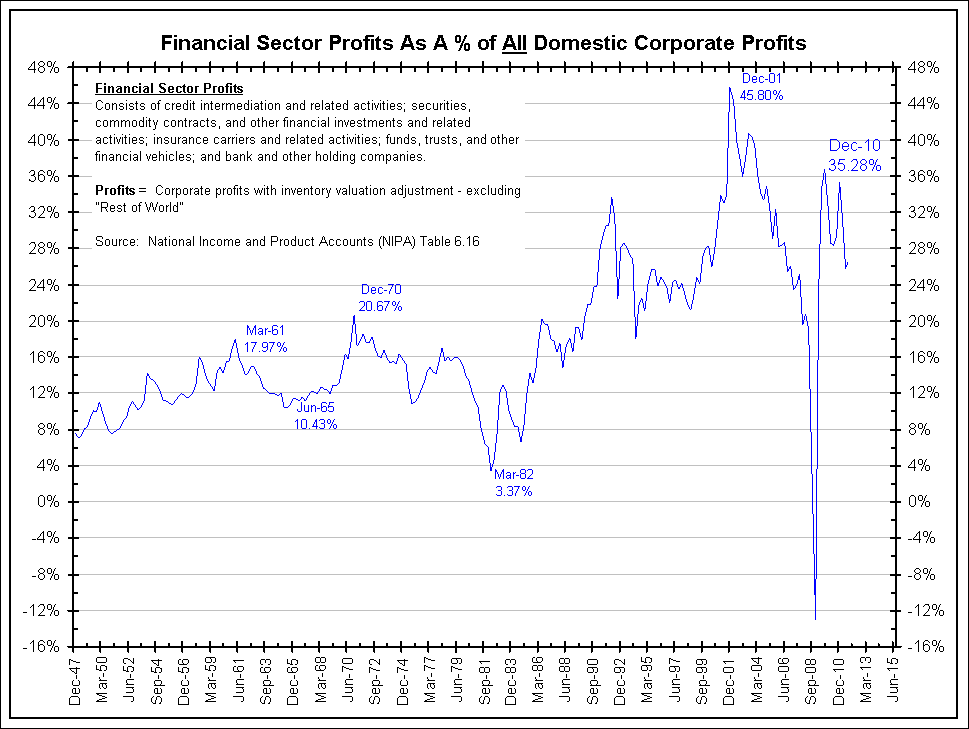
Those who have the least often give the most. Excessive income inequality (especially when driven by fraud) leads to a moral and cultural rot. Financial cartels & governments can only enslave people in so much debt & hand out so much soma before they either revolt or simply lose faith.
(On a related note, December saw record gun sales.)
State actors have repeatedly use violence to try to encourage a similar response. Instead they created a viral meme & the movement lives on.
Of course there are "opposition research" hacks willing to dig up dirt on anyone with wide reach who opposes the state-sponsored fraud: "It will be vital,? the memo says, ?to understand who is funding it and what their backgrounds and motives are. If we can show that they have the same cynical motivation as a political opponent it will undermine their credibility in a profound way.?
The state has long manipulated mainstream media and has tools for spying on social networks, hacking accounts & astroturfing online, but sock puppets can only go so far against reality.
We have an SEC that shreds over a decade of evidence (and engages in other illegal behaviors), a government that bails out the criminal enterprises & a court system that broadly makes it nearly impossible to win a financial fraud lawsuit.
The biggest companies & the biggest people in business at this point are simply above the rule of law & are not held accountable for their actions. Worse yet, the corrupt system has global influence.
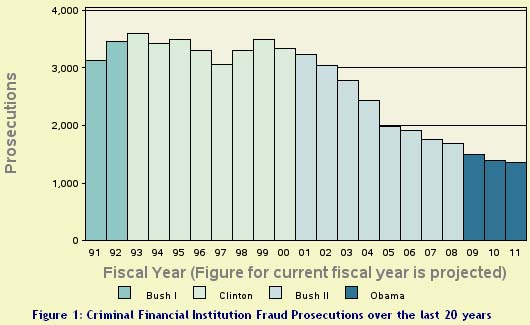
Henry Kissinger has a famous quote about power: "Before the Freedom of Information Act, I used to say at meetings, ?The illegal we do immediately; the unconstitutional takes a little longer.? [laughter] But since the Freedom of Information Act, I?m afraid to say things like that." Since then government officials have become much more evasive & smooth talking. Unfortunately, freedom of the press only goes so far:
this is how the much-lauded "freedom of the press" myth in the US actually works. If you perform the job of an actual journalist, telling truth to power, forget about attending press conferences at the White House, Pentagon or State Department. You won't even be admitted in the building.
When you ask for total market transparency it changes nothing with the criminality at the top, but it does create a juicy data source for criminals while harming personal civil liberties & unpeople with limited power:
The people who most heavily rely on pseudonyms in online spaces are those who are most marginalized by systems of power. ?Real names? policies aren?t empowering; they?re an authoritarian assertion of power over vulnerable people.
Source: http://www.seobook.com/transparency
link building use seo seo tools seo tool land seo leaders online
