Source: http://www.searchbliss.com/rank.asp
seo leaders online traffic mystic good backlink see book link building
Source: http://www.searchbliss.com/rank.asp
seo leaders online traffic mystic good backlink see book link building
Source: http://www.jux2.com/
Sharing is caring!
Please share :)
If you find the following a bit hard to read due to font size, a wider version is located here.
When monopolies state that they want to "level the playing field" it should be cause for concern.
Groupon is a great example of how this works. After they turned down Google's buyout offer, Google responded by...
The same deal is slowly progressing in the cell phone market: ?we are using compatibility as a club to make them do things we want."
Ahead of the Penguin update Google claimed that they wanted to "level the playing field." Now that Google shopping has converted into a pay-to-play format & Amazon.com has opted out of participation, Google once again claims that they want to "level the playing field":
?We are trying to provide a level playing field for retailers,? [Google?s VP of Shopping Sameer Samat] said, adding that there are some companies that have managed to do both tech and retail well. ?How?s the rest of the retail world going to hit that bar??
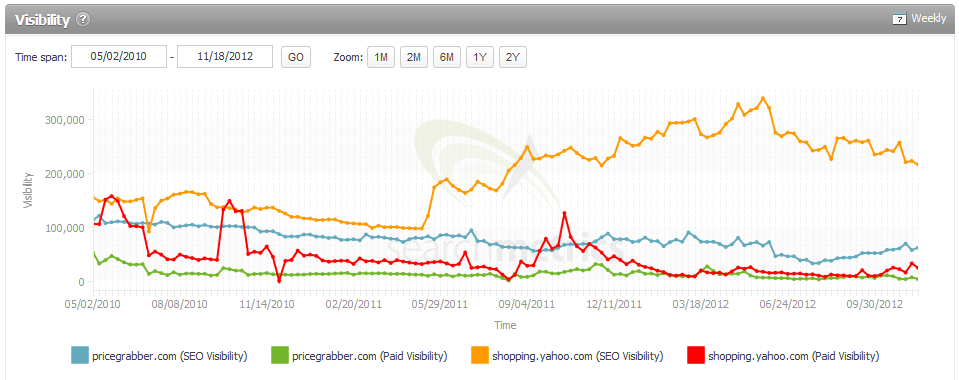
This quote is particularly disingenuous. For years you could win in search with a niche site by being more focused, having higher quality content & more in-depth reviews. But now even some fairly large sites are getting flushed down the ranking toilet while the biggest sites that syndicate their data displace them (see this graph for an example, as Pricegrabber is the primary source for Yahoo! Shopping).
Google has spent much of the past couple years scrubbing smaller ecommerce sites off the web via the Panda & Penguin updates. Now if small online merchants want an opportunity to engage in Google's search ecosystem they have a couple options:
Ignoring search isn't a lasting option, some of the PPC costs won't back out for smaller businesses that lack a broad catalog to do repeat sales against to lift lifetime customer value, SEO is getting prohibitively expensive & uncertain. Of these options, a good number of small online merchants are now choosing #4.
Operating an ecommerce store is hard. You have to deal with...
Some services help to minimize the pain in many of these areas, but just like people do showrooming offline many also do it online. And one of the biggest incremental costs added to ecommerce over the past couple years has been SEO.
How are the smaller merchants to compete with larger ones? Well, for starters, there are some obvious points of influence in the market that Google could address...
Ecosystem instability taxes small businesses more than larger ones as they...
The presumption that size = quality is false. A fact which Google only recognizes when it hits their own bottom line.
About a half-year ago we had a blog post about 'Branding & The Cycle' which stated:
algorithmically brand emphasis will peak in the next year or two as Google comes to appreciate that they have excessively consolidated some markets and made it too hard for themselves to break into those markets. (Recall how Google came up with their QDF algorithm only *after* Google Finance wasn't able to rank). At that point in time Google will push their own verticals more aggressively & launch some aggressive public relations campaigns about helping small businesses succeed online.
Since that point in time Amazon has made so many great moves to combat Google:
All of that is on top of creating the Kindle Fire, gaining content streaming deals & their existing strong positions in books and e-commerce.
It is unsurprising to see Google mentioning the need to "level the playing field." They realize that Amazon benefits from many of the same network effects that Google does & now that Amazon is leveraging their position atop e-commerce to get into the online ads game, Google feels the need to mix things up.
If Google was worried about book searches happening on Amazon, how much more worried might they be about a distributed ad network built on Amazon's data?
Said IgnitionOne CEO Will Margiloff: ?I?ve always believed that the best data is conversion data. Who has more conversion data in e-commerce than Amazon??
?The truth is that they have a singular amount of data that nobody else can touch,? said Jonathan Adams, iCrossing?s U.S. media lead. ?Search behavior is not the same as conversion data. These guys have been watching you buy things for ? years.?
...
Amazon also has an opportunity to shift up the funnel, to go after demand-generation ad budgets (i.e. branding dollars) by using its audience data to package targeting segments. It's easy to imagine these segments as hybrids of Google?s intent-based audience pools and Facebook?s interest-based ones.
Google is in a sticky spot with product search. As they aim to increase monetization by displacing the organic result set they also lose what differentiates them from other online shopping options. If they just list big box then users will learn to pick their favorite and cut Google out of the loop. Many shoppers have been trained to start at Amazon.com even before Google began polluting their results with paid inclusion:
Research firm Forrester reported that 30 percent of U.S. online shoppers in the third quarter began researching their purchase on Amazon.com, compared with 13 percent who started on a search engine such as Google - a reversal from two years earlier when search engines were more popular starting points.
Who will Google partner with in their attempt to disrupt Amazon? Smaller businesses, larger corporations, or a mix of both? Can they succeed? Thoughts?
Source: http://www.seobook.com/leveling-playing-field
seo tools seo tool land seo leaders online traffic mystic good backlink
Source: http://www.xml-sitemaps.com
seo leaders online traffic mystic good backlink see book link building
Ranking well for our chosen keywords involves putting in a lot of effort up front, with no guarantee of ranking, or reward.
Even if we do attain rankings, and even if do get rewarded, there is no guarantee this situation will last. And this state of flux, for many seos, is only likely to get worse as Google advises that updates will be ?jarring and julting for a while?
Even more reason to make every visitor count.
If we can extract higher value from each visitor, by converting them from visitor to customers, and from short term customers to long term customers, then our businesses are less vulnerable to Google?s whims. We don?t need to be as focused on acquiring new visitors.
There is great value to be had in optimizing the entire marketing chain.
It comes down to cost.
According to a Harvard Study a few years back, it can cost five times as much to acquire a new customer as it does to keeping a current customer happy. Of course, your mileage may vary, as whether it really costs five times as much, or three, or seven really depends what your cost structure.
However, this concept is an important one for search marketers, as it?s reasonable to assume that the cost of acquiring customers, via keyword targeting, is rising as Google makes the marketing process of keyword targeting more expensive than it has been in the past. This trend is set to continue.
If the cost of customer acquisition is rising, it can make sense to look at optimizing the offer, the conversion rates and optimizing the value of existing customers.
If you have something a lot of people desperately need, and there isn?t much competition, it typically doesn?t cost much to land those customers. They come to you. If you have something genuinely scarce, or even artificially scarce, people will line up.
The problem is that most businesses don?t enjoy such demand. They must compete with other businesses offering similar products and services. So, if there is a scarcity issue, it?s a scarcity of customers, not service and product providers.
However, by focusing on a specific niche, businesses can eliminate a lot of competition, and thereby reduce the marketing cost. For example, a furniture manufacturer could conceivably make furniture for a wide variety of customers, from commercial offices, to industry, to the home.
But if they narrowed their focus to, say, private jet fit-outs, they eliminate a lot of their competition. They?d also have to determine if that niche is lucrative, of course, but as you can see, it?s a way of eliminating a lot of competition simply by adding focus and specialization.
By specializing, they are more likely to enjoy higher quality leads - i.e. leads that may result in a sale - than if they targeted broadly, as it is difficult to be all things to all people The cost of marketing to a broad target market can be higher, as can the level of competition in the search results pages, and the quality of leads can be lower.
Once we?re focused on our niche, and we?ve got targeted visitors coming in, how can we ensure fewer visitors are wasted?
Those who do a lot of PPC will be familiar with conversion optimization, and we?ll dive deep into this fascinating area over the coming weeks, but it?s a good concept for those new to SEO, and internet marketing in general, to keep at front of mind.
You?ve gone to a lot of trouble to get people to your site, so make sure they don?t click back once they arrive!
Here?s a great case study by a company called Conversion Rate Experts. It outlines how to structure pages to improve conversion rates. Whilst the findings are the result of testing and adaptation, and are specific to each business, there are a few few key lessons here:
Length of the page. In this case, a long page improved conversion rates by 30%. Of course, it?s not a numbers game, more the fact that the longer page allowed more time to address objections and answer visitor questions.
As Conversion Rate Experts point out:
The media would have us believe that people no longer have any capacity to concentrate. In reality, you cannot have a page that?s too long?only one that?s too boring. In the case of Crazy Egg?s home page, visitors wanted their many questions answered and that?s what we delivered. (If you?d like more people to scroll down your long pages, see the guide we wrote on the topic.)?
It?s best to experiment, to see what works best in your own situation, but, generally speaking, it pays to offer the visitor as much timely information as possible, as opposed to short copy if there is a analytical, need-oriented motivation. Short copy can work better if the customer is impulsive.
As we see in the Crazy Egg case study, by anticipating and addressing specific objections, and moving the customer closer to the point of sale, the webpage is doing the job of the salesperson. This is an area where SEO and PPC, linked with conversion rate optimization, can add a ton of value.
The second interesting point was they optimized the long-term value of the customer to the company by making a time-sensitive offer.
The one-time offer test illustrates another important principle of conversion optimization: Don?t let the fear of a short-term loss stand in the way of a long-term gain
The offer they made turned a short-term customer into a long-term customer. If we have a lot of long term customers on our books, it can take some of the pressure off the need to constantly acquire new customers.
We engage in SEO because there are many similar sites.
The benefit of SEO is we can occupy premium real estate. If we appear high on the search result pages, we are more likely than our competitors to command the customers attention. But we stand to gain a lot more stability if we are not wholly reliant on occupying the top spots, and therefore less vulnerable to Google?s whims.
Source: http://www.seobook.com/insulating-ourselves-googles-whims
use seo seo tools seo tool land seo leaders online traffic mystic
Sharing is caring!
Please share :)
If you find the following a bit hard to read due to font size, a wider version is located here.
Source: http://www.seobook.com/obfuscation-and-misdirection
seo leaders online traffic mystic good backlink see book link building
On Feb. 25, 2011, Google released Panda to wreak havoc on the web. While it may have been designed to take out content farms, it also took out scores of quality e-commerce sites. What do content farms and e-commerce sites have in common? Lots of pages. Many with zero or very few links. And on e-commerce sites with hundreds or thousands of products, the product pages may have a low quantity of content, making them appear as duplicate, low quality, or shallow to the Panda, thus a target for massive devaluation.
My e-commerce site was hit by Panda, causing a 60% drop in traffic overnight. But I was able to escape after many months of testing content and design changes. In this post, I'll explain how we beat the Panda, and what you can do to get your site out if you've been hit.
The key to freeing your e-commerce site from Panda lies at the bottom of a post Google provided as guidance to Pandalized sites:
One other specific piece of guidance we've offered is that low-quality content on some parts of a website can impact the whole site?s rankings, and thus removing low quality pages, merging or improving the content of individual shallow pages into more useful pages, or moving low quality pages to a different domain could eventually help the rankings of your higher-quality content.
Panda doesn't like what it thinks are "low quality" pages, and that includes "shallow pages". Many larger e-commerce sites, and likely all of those that were hit by Panda, have a high number of product pages with either duplicate bits of descriptions or short descriptions, leading to the shallow pages label. In order to escape from the Panda devaluation, you'll need to do something about that. Here are a few possible solutions:
If your site has a relatively small number of products, or if each product is unique enough to support entirely different descriptions and information, you may be able to thicken up the pages with unique, useful information. Product reviews can also serve the same purpose, but if your site is already hit by Panda you may not have the customers to leave enough reviews to make a difference. Additionally, some product types are such that customers are unlikely to leave reviews.
If you can add unique and useful information to each of your product pages, you should do so both to satisfy the Panda and your customers. It's a win-win.
Some e-commerce sites have large numbers of products with slight variations. For example, if you're selling t-shirts you may have one design in 5 different sizes and 10 different colors. If you've got 20 designs, you've got 1,000 unique products. However, it would be impossible to write 1,000 unique descriptions. At best, you'll be able to write one for each design, or a total of 20. If your e-commerce site is set up so that each of the product variations has a single page, Panda isn't going to like that. You've either got near 1,000 pages that look like duplicates, or you've got near 1,000 pages that look VERY shallow.
Many shopping carts allow for products to have variations, such that in the above situation you can have 20 product pages where a user can select size and color variations for each design. Switching to such a structure will probably cause the Panda to leave you alone and make shopping easier for your customers.

If your products aren't sufficiently unique to add substantial content to each one, and they also don't lend themselves to consolidation through selectable variations, you might consider deleting any that haven't sold well historically. Panda doesn't like too many pages. So if you've got pages that have never produced income, it's time to remove them from your site.
This is a bold step, but the one we were forced to take in order to recover. A great many of our products are very similar. They're variations of each other. But due to the limitations of our shopping cart combined with shipping issues, where each variation had different shipping costs that couldn't be programed into the variations, it was the only viable choice we were left with.
In this option, you redesign your site so that products displayed on category pages are no longer clickable, removing links to all product pages. The information that was displayed on product pages gets moved to your category pages. Not only does this eliminate your product pages, which make up the vast majority of your site, but it also adds content to your category pages. Rather than having an "add to cart" or "buy now" button on the product page, it's integrated into the category page right next to the product.
Making this move reduced our page count by nearly 90%. Our category pages became thicker, and we no longer had any shallow pages. A side benefit of this method is that customers have to make fewer clicks to purchase a product. And if your customers tend to purchase multiple products with each order, they avoid having to go from category page to product page, back to the category page, and into another product page. They can simply purchase a number of products with single clicks.
If you do get rid of all links to your product pages but your cart is still generating them, you'll want to add a "noindex, follow" tag to each of them. This can also be a solution for e-commerce sites where all traffic enters on category level pages rather than product pages. If you know your customers are searching for phrases that you target on your category pages, and not specifically searching for the products you sell, you can simply noindex all of your product pages with no loss in traffic.
If all of your products are in a specific folder, I'd recommend also disallowing that folder from Googlebot in your robots.txt file, and filing a removal request in Google Webmaster Tools, in order to make sure the pages are taken out of the index.
In addition to issues with singular product pages, your e-commerce site may have duplicate content issues or a very large number of similar pages in the index due to your on-site search and sorting features. Googlebot will fill in your search form and index your search results pages, potentially leading to thousands of similar pages in the index. Make sure your search results pages have a rel="noindex, follow" tag or a rel="canonical" tag to take care of this. Similarly, if your product pages have a variety of sorting options (price, best selling, etc.), you should make sure the rel="canonical" tag points to the default page as the canonical version. Otherwise, each product page may exist in Google's index in each variation.
Maxmoritz, a long time member of our SEO Community, has been working in SEO full time since 2005. He runs a variety of sites, including Hungry Piranha, where he blogs regularly.
Source: http://www.seobook.com/how-free-your-e-commerce-site-googles-panda
Source: http://www.trafficmystic.com/245/the-best-methods-for-making-mobile-marketing-successful/
seo tool land seo leaders online traffic mystic good backlink see book
Source: http://www.pageranktool.net/
Getting traffic to a site is one thing. How do we best engage visitors once they arrive?
Since Update Penquin/Panda, engagement metrics have become more important. In order for our sites to rank well, we need to avoid the bounce - the immediate click-back - or we?re likely to experience drops in ranking. We need to pull visitors deeper into our site. We need more genuine engagement.
Even if engagement metrics had no impact on rankings, optimizing for engagement is always going to be beneficial. The more engaged our audience, the more influence we?re likely to have, and we derive the benefits that flow from it.
Here are a few ideas on visitor engagement, and how to optimize for it.
When visitors have so many options, it?s difficult to engage them for long. We can?t accommodate every need on one site. It?s certainly impossible to accommodate every need within one or two clicks. So, to make the most of every opportunity, we should be optimizing engagement factors.
One problem with content-based approaches is that they tend to be top-down. The visitor is assumed to be a somewhat passive recipient of published information. However, at the heart of engagement is a two-way conversation. In order to foster engagement, we must encourage participation, as opposed to simply deliver content.
The web is moving from an information age to a relationship age. Social media demonstrates that information is intersecting in new ways. Information is being sliced, diced, repurposed, remixed and redelivered, turning ?recipients? into producers. The act of consumption changes the information, and often creates new information. Conversation, as discussed in the Cluetrain Manifesto, is crucial in this new economy.
?Historically, the authors state, the marketplace was a location where people gathered and talked to each other: they would discuss available products, price, reputation and in doing so connect with others (theses 2?5.) The authors then assert that the internet is providing a means for anyone connected to the internet to re-enter such a virtual marketplace and once again achieve such a level of communication between people. This, prior to the internet, had not been available in the age of mass media (thesis 6.)?
And that conversation will largely be decided by our visitors. It certainly reshapes marketing. To give an offline example, what?s the problem with marketing television and radio? We watch or listen to the content, but the marketing keeps jumping in, which is intrusive and disruptive.
Engagement Marketing is the opposite. The marketer hangs back and engages with the visitor of and when they need it. Look for ways the visitor can initiate and direct the engagement.
How do we best measure engagement?
We start with a benchmark, which is the current level of engagement. We could look at the engagement link in Google Analytics. Typical measurements include time on site, pages per visit, inbound links, mentions on twitter, return visits, new users per date range, categories of interest, and page depth.
All good. If those metrics increase, it certainly feels like we?re being more engaging. One example might be to examine visitor flow through the site. If we can identify bottlenecks - the point where engagement breaks down - then we can adjust our approach at this point to clear the bottleneck.
But we need to be sure this engagement benefits us. Are these metrics aligned with our business goals? People might well be spending a lot of time on our site, but that might be because they?re lost. We might be getting a lot of mentions on Facebook and Twitter, but are these people actually buying anything? Mentions on Twitter & Facebook might be great metrics for a brand strategy, but not so great for conversion strategy, at least, not in the short term, and not in isolation.
Engagement must translate, and be aligned with, business goals. When choosing what engagement metrics to measure, ask yourself how this type of engagement helps achieve your goals. Also, are there other types of engagement we could foster to support own goals?
This video is a little sales pitch-y, but contains some interesting lessons on optimizing engagement.
Optimizer, Dan Siroker, who once worked for Google before moving onto the Obama campaign talks about how they used metrics to increase engagement. Both Obama campaigns have demonstrated effective use of digital engagement and measurement to help produce a desired election result. The techniques involve establishing a baseline i.e. seeing what they do already and increasing performance by making tweaks and adjustments, and measuring the result.
He found that, generally speaking, these rules apply when optimizing for engagament:
Start By Defining Success: How will you know if your engagement optimization has worked? Decide on a few, quantifiable measures based around a visitor taking a desirable action. Link those actions to business return.
Less Is More - if we reduce choice, people are more likely to engage. In this example, they reduced the fields people needed to fill in to only those actually required, rather than all the information that may be desirable. Look for ways you can streamline and thus boost engagement.
Words Matter - focus on your call to action. Calls to action tend to work best when you tell the visitor exactly what they have to do. Be explicit. In this example, they compared the phrase ?Free trial? vs ?Try It Free?. The latter resulted in 14.6% improvement. This was most likely because it was an explicit call to action. However, the ?why? doesn?t really matter. The point is to measure one thing against another and see what actually works.
Fail Fast And fail cheap!. It?s all about being iterative. Being flexible. Trying things out. The underlying presumption is that a lot of things we do aren?t going to work, no matter how logical and rational they seem to be when we devise them.
So, rather than be afraid to make a change, as this may result in failure, grasp the opportunity to make a change and be sure to ?fail fast?. If something is not working out, cut it quickly, and try something else, until it does work. If it hurts, dump it quick and move on.
Start Today It?s easy to talk about being engaging, but what really matters is taking action to be more engaging. If there?s one thing you can do today to make your site more engaging, what would it be? Go do that. Test it. And then do something else tomorrow :)
In the video, Dan talks mostly about process changes. Another area is, of course, web design.
This article talks about the influence of design on engagement, based on opinion on what design is preferable to another.
If we go back to the rules of engagement, the important thing to do is to test. Test one design against each other to see which is more engaging based on desired visitor action. Ensure the engagement measurement is aligned with a business goal i.e. ?we want more 50% orders via our web site?.
Do Blogs, Twitter and Facebook help you meet your engagement goals?
Is anyone reading our posts? If they do, what do they do next? Anything? Many people are very busy in this space, but generate little or no return on investment. When it comes to engagement, it?s one thing to measure activity, quite another to measure if that activity actually means something.
Part of the problem is not focusing on ROI. Determine your business goals, then shape your social media approach to bring about these goals. One example might be ?Twitter traffic makes a donation to our cause?. We?d measure the Twitter traffic, and link it to a successful donation.
This is a good example of where metrics can be deceptive. If we measured Twitter traffic, and time on site, and depth of their activity on-site, that might look great in terms of engagement, but if it doesn?t serve a business purpose, then why are we doing it? If people spend more time on site, is that good? Well, not if we want them to sign up, but they didn?t
There is no substitute for relevance. Relevance is the first, essential step. The next step is pull the visitor in, get them contributing, and get them coming back.
Alan Moore, Director of the Comparative Media Studies Program at MIT, puts it well:
Engagement marketing is ?premised upon: transparency - interactivity - immediacy - facilitation - engagement - co-creation - collaboration - experience and trust, these words define the migration from mass media to social media. The explosion of: Myspace, YouTube, Second Life and other MMORPG's, Citizen Journalism, Wicki's and Swicki's, TV formats like Pop Idol, or Jamies School Dinners, Blogs, social search, The Guinness Visitor Centre in Dublin or the Eden project in Cornwall UK, mobile games like Superstable or Twins, or, new business platforms like Spreadshirt.com all demonstrate a new socio-economic model, where engagement sits at the epicentre
In order for the following media examples and strategies to work well, they should have as many of these qualities - transparency - interactivity - immediacy - facilitation - engagement - co-creation - collaboration - experience and trust - as possible. No doubt you've experienced the frustration of heavily moderated and delayed visitor comments on mainstream media acticles. They rob the interaction of immediacy and trust, so it?s no wonder their business model is dying in the face of relatively open and immediate citizen media and reporting.
A quality content strategy is likely to keep people reading, bookmarking, and coming back. Quality is, of course, relative. Compare your content with that of your opponents. Obviously, your stuff needs to be better. Even if people do click away, they may well return if they look at your competitors and find their quality lacking.
Video and audio are linear, so people, once engaged, are likely to engage as long as the media lasts. Likewise, webcasts engage people in the same way, with the added bonus that visitors can interact, if they wish. If increasing time on site aligns with your business goals, then video and audio might be good media to try.
People love giving their opinion. Look for ways to allow them to do so. Blog comments, obviously. Forums. Encouraging people to Tweet or post to their favored social media channel. Implement chat applications, where appropriate, to seek direct feedback. Amazon?s value is considerably increased by their review system - by giving their customers a voice, whether their opinion is positive or negative.
Use mailing lists. These are especially useful for up sells and cross sells post-purchase. Up-sells are when you encourage the customer to buy something more expensive. Cross-selling is when we sell the existing customer an additional item. I receive special discounts from a clothing retailer I buy from on a regular basis, based on my previous buying history. This retains engagement after I've left the site, and because it's relevant and beneficial, it doesn't feel intrusive. It?s considerably more expensive to get a new customer, rather than look after those customers you?ve got, so look for ways to pass on that value to existing customers. They are likely to be highly receptive and willing to engage, as you?ve already convinced them once.
Brand. A huge topic, but let?s take a look at brand in terms of engagement. A brand is an experience. We associate feelings and thoughts with a brand. Apple?s brand is as much about technology as it is about fashion, desirability and identity. Apple creates engagement on a number of levels, but perhaps the most effective is that you become a ?member of a club? when you buy an Apple product. The sense of belonging, and defending and asserting your purchase in the cleverly constructed ?Apple vs everything else? debate creates a deep level of engagement.
Try to foster a sense of community. It runs very deep in the human psyche. We used to get a sense of community by geographic location. but now our sense of community is largely defined by the tribes to which we belong.
Source: http://www.seobook.com/engagement-marketing
link building use seo seo tools seo tool land seo leaders online
Source: http://www.seochat.com/seo-tools/pagerank-search/
use seo seo tools seo tool land seo leaders online traffic mystic
Source: http://www.seochat.com/seo-tools/pagerank-lookup/
link building use seo seo tools seo tool land seo leaders online
Source: http://www.devppl.com/msnbetarankings.php
seo leaders online traffic mystic good backlink see book link building