Source: http://www.seo-leaders-online.co.za/seo/steps-to-take-get-better-at-e-mail-marketing/
use seo seo tools seo tool land seo leaders online traffic mystic
Source: http://www.seo-leaders-online.co.za/seo/steps-to-take-get-better-at-e-mail-marketing/
use seo seo tools seo tool land seo leaders online traffic mystic
Source: http://www.webconfs.com/http-header-check.php
seo tools seo tool land seo leaders online traffic mystic good backlink
Source: http://www.furl.net
link building use seo seo tools seo tool land seo leaders online
Source: http://www.mkpitstop.com/Art/154207/94/Avoiding-Online-Spam-When-Job-Hunting-3-Key-Tips.html
Walmart is getting much more aggressive with their online strategy:
With some 1.4 million employees on its U.S. payroll, Walmart's world is about as large as the state of Maine. That's massive by any standard, but when you consider how social media amplifies that number, it's not simply a huge group but an influential one. No small wonder, then, that the earth's largest employer is taking greater measures to motivate and mobilize its people -- and opening up more opportunities for consumer brands to also reach them along the way.
These brands can not only leverage internal resources to further build off the boost Google offers them, but they can then take that attention and sell it back off to the highest bidder:
It's not clear how much ad revenue Walmart World has made or whether MyWalmart.com will become a profit center. But the former already takes in millions of dollars annually in ads from vendors seeking an audience with Walmart employees, according to people familiar with the matter.
If Google consolidates markets too aggressively then ultimately they create competition for themselves through vertical ad networks. In some cases (say travel) Google can buy out the market plumbing & then reassert control:
Wertheimer drew some criticism when he explained that ?our airline partners were very clear? that they wouldn?t participate in Google Flight Search if online travel agency booking links were included in the core flight-search results.
But Google doesn't have that same influence over retail & each time they put the big brands front and center the more they reinforce that 3rd party dominance.
In addition to leveraging their workforce, it is also quite easy for these brands to use customer incentives to dominate social media.
Amazon.com is also carrying far more ads these days & they sell ads on 3rd party sites.
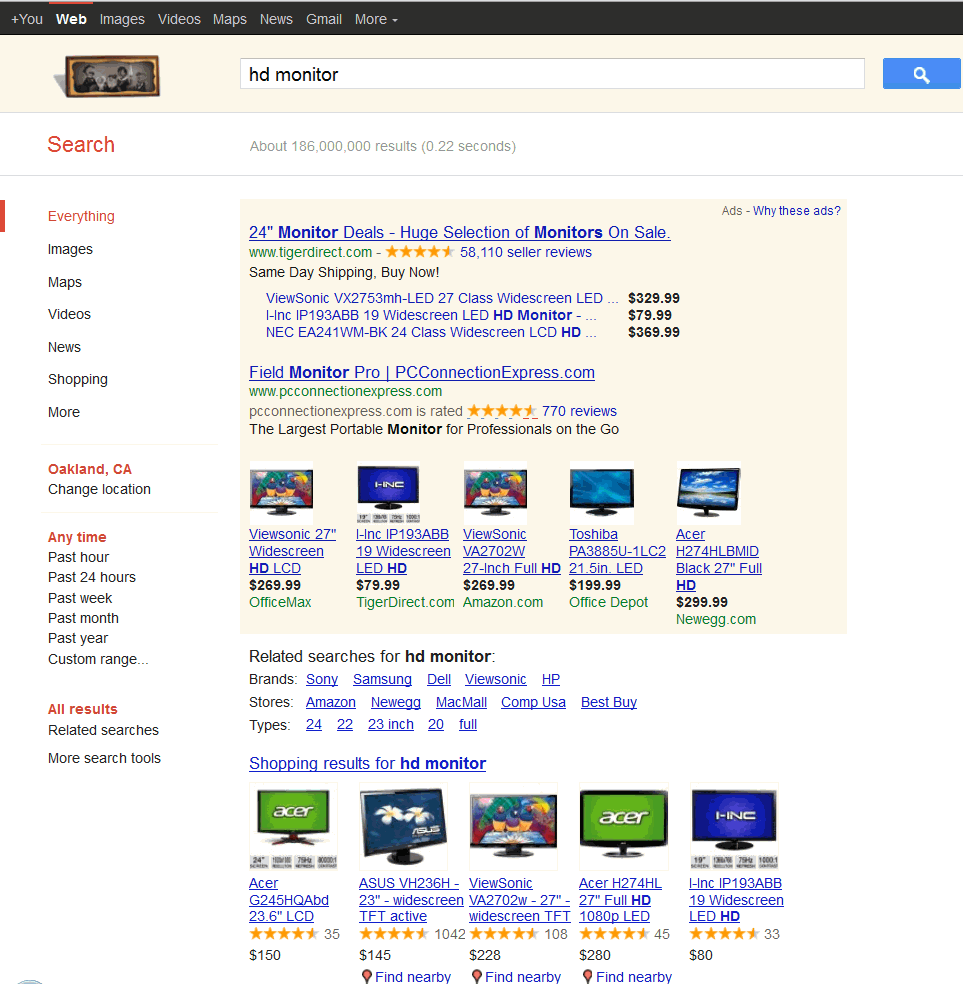
The above is another reason why Google is pushing so hard to control the second click. If they can taste the traffic again they add efficiency to their own model while introducing another layer of friction to other retailers.
When users finally manage to leave the Google click circus, Google tries to pull them back into Google with the Google Related toolbar
In the above quoted AdAge article there is some skepticism around how much a company like Walmart can get out of underpaid wage slaves:
"It's really hard when you're a person making poverty-level wages, just had your health-care premiums raised 60%, and you can only get part-time hours, to be a good ambassador for the brand, no matter how much you love it," said Jennifer Stapleton, spokeswoman for Making Change at Walmart.
However I think that skepticism is misplaced, as the less a person has the more thankful they tend to be for the little bits they do have. Most people who have nothing do not realize how systems are engineered to screw them over.
It is only when you have free time to think & are not clouded by arbitrary short-term stress that you can ponder the bigger & more uncomfortable questions in life. As long as you don't consider those uncomfortable questions it is far easier to push anything, because you don't know any better.
"The entire web has become full of garbage. The web has become almost a digital Detroit." - Roger McNamee.
If Walmart's strategy works then this ultimately will be why Google's brand-only approach to search will fall flat on its face. If this is successful I would then expect Google to put out some public relations drivel about celebrating the diversity of the web & move away from brand in the next 2 or 3 years.

Google's ad network is far more profitable than even the lowest waged employee, as it doesn't need to be fed & is designed to be an agnostic & amoral yield optimization tool. And it is effective enough that the biggest retailers are now becoming ad networks.
Average products for average people - with ads everywhere.
Welcome to the WorldWideMart. ;)
Source: http://www.seobook.com/walmartization
seo tools seo tool land seo leaders online traffic mystic good backlink
Buzzstream recently rolled out a beautiful UI update and I've been impressed with their offering for awhile now.
We like to review products which we ourselves use , as well as products that we feel are impressive. For me, Buzzstream fits both of those characteristics.
Buzzstream is a tool that I am fully adding to my toolset for 2012 and I think you should give it a shot as well.
Buzzstream has two products:
We will be focusing on the link building tool in this post. Buzzstream for Link Building focuses solely on link building functionality from soup (prospecting) to nuts (tracking, reporting, relationship management).
One of my favorite aspects of this tool is it's dedicated nature. It focuses on making link building more collaborative, more scalable, and more effective. It does all three quite well and reinforces the belief that sometimes a dedicated tool is the answer.
Link building has come so far in recent years with respect to things like degree of difficulty, requirements of quality, as well as the need to track links and manage relationships.
Link building is such a key piece of an online marketing campaign (not just passing link juice but bringing in targeted, quality traffic and building up brand equity) to the point where I think having a robust tool for it makes a lot of sense; especially when you can use a tool like Buzzstream for it.
Here are some of the key features of Buzzstream that we'll be covering here:
The dashboard gives you a good, high-level overview of your account's history and tasks.
You can filter the history by:
The filtering capabilities are solid and make project spot checks very easy. For a quick export of your history, in .csv format just click on the folder to the left of the task area (in the right column).
Here is what the dashboard looks like:
To the right of the history pane is the task pane as well as recently viewed link prospects. The task pane also offers some good filtering capabilities:
I like the clean, visual look of the dashboard as well as the quick and helpful filtering capabilities. If you are running multiple campaigns with multiple members involved then I think you'll quickly appreciate the way Buzzstream has structured their dashboard.
To begin your link prospecting search, you can go to the Websites link and jump right in.
Then click on the Prospects icon to start your research. Here, you will need to set up a profile and up to 20 keywords and keyphrases for the search. I usually name the search after the main keyword I'm looking for, so in this case we'll rock SEO Tools and I'll throw in a couple more specific keywords for the search function.
In addition to prospecting you can specifically search the following countries:
You also have your choice between website results, news results, and blog results under the Search Type option.
Also, you can have this auto-run daily for new results (which is a great feature!) as well as have notifications sent to a specific person (you or a team member or contractor) when new results arrive.
If you no longer wish to receive results but want to save the search for later, just click the inactive button and reactivate when needed.
Another cool feature here is the blacklist feature. Dump in sites you wish to exclude from your searches on a per project or account-level basis. This is extremely helpful for streamlining new prospecting searches across your entire account. Block out competitors, your other properties, sites you know you'll never get a link from, etc).
When you open the profile again you are presented with the results.
The results come with default columns but you can click the Columns icon to play with tons and tons of additional, useful options
Click on that and get all these column options:
Buzzstream does a good job here of giving you control over so many different options. The other nice thing here is you can add a bunch of metrics or customize whatever you want, do a quick export, and set everything back to normal if you don't want or need all these metrics every time.
Here's a snippet of what the results look like with no filtering:
From here you can do all sorts of filtering with just about all of the options I outlined above. You can also click on a specific link and manage it at any point:
From here you can do just about anything:
Also, you can see the Twitter, FB, email, and phone icons next to each link. Buzzstream will pull those in when available. You can also add a site yourself but clicking the Add Site button where you can add as much or as little info as you have or want:
What I like to do is update the search with all the SEO related metrics and then filter (not looking for addresses or anything at this point, just SEO metrics).
Here are the filtering options:
The options pretty much cover everything you can add as a metric to their prospect results page. You can also create a specific filter and save it for future use (a big time saver for ongoing prospect research).
Once you are done filtering out the junk you can begin to work the prospect list by:
Once the link is secured you can simply add it to the tracking and reporting component by clicking on the link and selecting "approve".
There are so many filtering options and editing options, as mentioned above, that I really encourage you to get in there and play around with it. You can customize it to fit your specific link building needs (big or small) which is a really nice feature to have (a tool that can scale up or down with you and your business).
I went ahead and approved the link-assistant.com domain as being a link I recently secured. To work with approved links you just need to move on over to the Links tab:
Again, you have a ton of filtering options here:
Buzzstream, via the Column tab, gives you lots of helpful data on a per link basis to help with overall link management and reporting:
You can also import all your links by clicking the import tab (Buzzstream gives you a template to use for this right from the import dialog box)
From here the next logical step is to set up link tracking to automatically notify you of any changes to links you are tracking.
Buzzstream offers automated and manual link tracking. Buzzstream will let you track the following link data types via their automated backlink checker (this runs every 2 weeks) and manual link checker:
You can select who receives this report, and the manual report via email. Manual reports can be completed by going to the links tab and clicking on the Run Backlink Checker Icon:
The report is then delivered to the specified email address (can be changed in project settings) in short order (longer for bigger checks of course).
I would recommend targeting the more important links here. There is a lot of churn on the web and link tracking tools, that are cloud based, do have tracking limits (Buzzstream comes in at 500 links for the basic plan, 25,000 for their Plus, and 100,000 for their Premium Plan). They also have a solo plan for 1 user and up to 1,500 tracked links.
They offer custom plans as well.
The link reporting is good and is one area where I think they can use some improvement (ability to spit out anchor text distribution reports, upload logos,
automated report emailing, etc).
To generate a report you click on the pie (mmmmm pie) icon on the Links page:
Once you click there you get 2 options:
Link Report - reporting on link opportunities and completed links
Spend Report - reporting on the cost of links that cost money
Here is the dialog box for the Links Report:
Export options are PDF, HTML, and XML for Word and Excel.
The Spend Report is clean and simple to read, here is the dialog box for that:
The reports are quick to generate and clean. I think if they add some more customization options it will be a homerun; it's still better than most reporting options out there.
You can store, add, and access key contacts and their contact information within the People tab
As with their other options there is a wide variety of filtering and column customization capability to help you slice, dice, and keep track of key contacts within a specific project (or through an entire account).
You can add in pertinent contact info like their name, numbers, associated websites, social network information, and so on. You can also keep a history of calls, notes, and emails (more on emails in a minute) right inside the contact's information center:
This is one of my favorite features. You can configure Buzzstream to automatically populate contact history on your link outreach campaigns:
If you are managing a team, or just your own link campaign really, this is a great feature to have. In addition to the other contact management features I mentioned above, this feature adds another layer of helpful contact management. Having CRM functionality inside of a link building tool is quite helpful when we talk about things like scaling link building campaigns and managing teams
When you add your email account you can also send email from Buzzstream. You can select any number of "People" or contacts that you want and work through them one by one by creating an email template (see below) and quickly customizing it to the specific person you are targeting
Using canned responses in Gmail is similar but the difference here is the integration with Buzzstream and the ease of going right through a selected list of contacts (and having it saved in their contact history automatically).
Lots of people use BuzzStream as a database of all their prospects/partners and then slice and dice them for campaigns. So, for example, suppose you are trying to secure guest posts. You go to All Contacts (contacts for your whole account, not just one project) and select everything tagged "finance" that's a "guest post" type and that's linked to you in the past.
After that, you take those contacts of known finance guest post opportunities, copy them to a new project and then work that list. You cover a lot of this in your filter descriptions. Essentially, use the tagging and filtering system to build your own database for rinse and repeat solutions.
You can also track Twitter stuff (which can get out of hand quickly in terms of back and forth contact, real time) and works the same way as Buzzstream's IMAP integration.
For the Twitter tracking you can basically import a bunch of twitter lists into BuzzStream, start retweeting their content and then filter to find everyone you've retweeted three days ago (filter by: Communication History=tweet, contact modified=3 days ago).
Save this filter and you have a list of people to follow up with on a regular basis. You can then send a template-based email that refers to the retweet and use that as a quick in to perhaps securing a link opportunity.
Buzzstreams' Buzzmarker gives you the ability to save a prospect's information from any browser. To set up the Buzzmarker you just go into your settings and drag the bookmarklet to your toolbar :D
Here is a snippet of the Buzzmarker dialog box:
Anytime you come across news stories, blog posts, and Twitter feeds that you want to store for future work inside of Buzzstream all you do is click on the Buzzmarker
The Buzzmarker pulls in lots of information and gives you options to do a variety of things like:
If you are looking for a strong link building tool which incorporates any of the features below, you should give Buzzstream a try:
Buzzstream is a quality link building and link management tool that is certainly worth trying out if you are engaged in link building activity. The reporting is stronger than most other options out there but I think they can do even better with it after seeing what they've done on the inside. If you do try them out let us know what you think in the comments!
Take it for spin, they have free trials available over at Buzzstream.Com.
Source: http://www.seobook.com/comprehensive-review-buzzstream
link building use seo seo tools seo tool land seo leaders online
Source: http://gsitecrawler.com/tools/server-status.aspx
link building use seo seo tools seo tool land seo leaders online